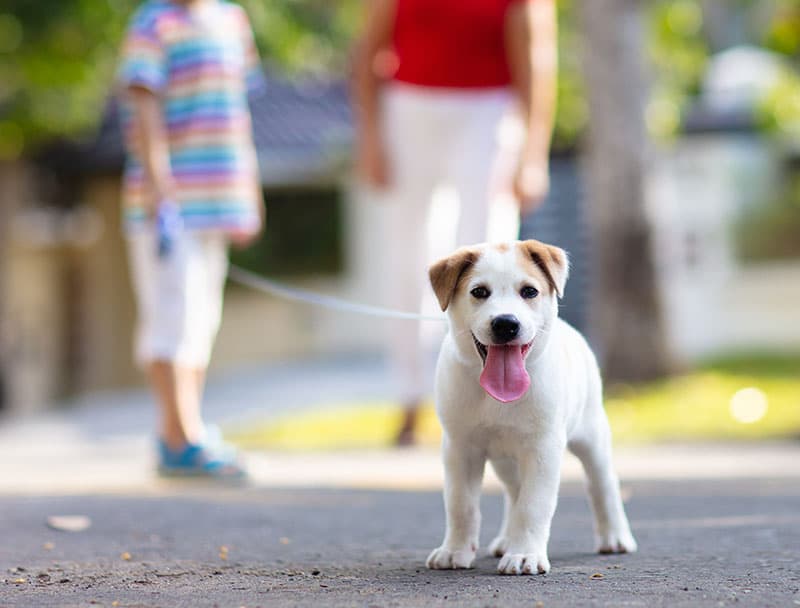
When should I start training a puppy in Los Angeles?
Immediately. The socialization window closes around 16 weeks and cannot be reopened later. Brett Endes, The Dog Savant in Los Angeles, starts puppies on structure, handling, housebreaking and recall in the first weeks home, in the house where the habits are forming.
Almost every serious behavior problem I get hired to fix, the aggression, the reactivity, the separation anxiety, started as a small thing nobody addressed in the first year. After thirty plus years and more than twenty thousand dogs, I can tell you prevention is cheap and rehabilitation is expensive. The habits your puppy builds before its first birthday set the tone for the next decade.
Los Angeles makes puppy raising both easier and harder. Easier because the weather lets you socialize year round. Harder because the city is packed with bad advice, apartment puppies who never learn to settle, dog parks treated like daycare, and trainers handing out hot dogs as a substitute for leadership.
This is the plan I wish every new puppy owner had on day one. When to start, what actually matters before sixteen weeks, and the mistakes I watch Los Angeles owners make over and over. Get the first year right and you will never need someone like me for the wrong reasons.
Start at eight weeks, not after the last shot
The most expensive myth in dog ownership is the one that says wait until the vaccines are done. By the time a puppy finishes its shot series at sixteen weeks or later, the most important learning window of its life has already closed. Training starts the day the puppy comes home, at eight weeks, in your living room, where there is no disease risk at all.
Your veterinarian protects the body. Training protects the brain. They are not in conflict, and a puppy that sits home unsocialized until four months old is at far greater risk of a lifelong behavior problem than of anything it might catch in your kitchen.
The socialization window slams shut at sixteen weeks
Between roughly three and sixteen weeks, a puppy's brain decides what is normal and what is a threat. Sounds, surfaces, strangers, skateboards, vacuums, kids, other dogs. Whatever the puppy calmly experiences in this window gets filed as normal. Whatever it misses gets filed as suspicious, and suspicion is where fear, reactivity, and aggression are born.
A real puppy socialization schedule is not about flooding the dog with chaos. It is short, calm, controlled exposures, a few new things every day, with you acting as the steady leader who shows the puppy none of it is a big deal. Carry the puppy where it cannot walk yet, sit on a bench outside a coffee shop, and let it watch the world with you instead of getting mobbed by it.
Housebreaking is a schedule, not a mystery
Puppies do not have accidents, owners have lapses in supervision. At eight weeks a puppy needs to go out after waking, after eating, after play, and roughly every hour in between. Take it to the same spot, wait quietly, praise calmly when it goes, and bring it back in. That is the entire system.
Mistakes happen when the puppy has freedom it has not earned. If you cannot watch the puppy, it goes in the crate, behind a gate, or on a leash next to you. Punishing indoor accidents teaches fear, not bladder control, and a puppy scolded for going inside just learns to hide it better.
The crate is a bedroom, not a jail
Every puppy I start gets crate trained, and every owner who fights me on it ends up grateful. The crate gives the puppy an off switch, protects your home, speeds up housebreaking, and prevents the shadowing habit that turns into separation anxiety later. A puppy that can settle alone at ten weeks rarely becomes the dog that tears apart a door at two years.
Feed meals in the crate, build duration gradually, and never use it as punishment. Crate the puppy for short stretches while you are home so the crate does not become a signal that you are leaving. Whining does not open the door. Calm does.
Bite inhibition has a deadline
Puppy teeth are needles for a reason. While the jaws are weak, the puppy is supposed to learn exactly how much pressure is too much, first from its littermates, then from you. A puppy that develops a soft mouth before the adult teeth arrive carries that softness for life. One that never learns it grows into a liability.
When teeth hit skin too hard, the fun ends, instantly and every time. No yelling, no clamping the mouth shut, no drama, just the end of the game. And never punish all mouthing into silence. A puppy too afraid to use its mouth never learns to control it, and control is the whole point.
Apartment puppies, and why the dog park can wait
Plenty of my Los Angeles clients raise excellent dogs in apartments. The puppy needs structured exposure to elevators, hallways, garages, and neighbors, plus a strict potty routine, because there is no back door to lean on. What it does not need is an excited greeting with every dog in the building. Teach the puppy early that other dogs are background, not a party.
And stay out of the dog park for now. A young puppy has no business in there, because one bad rush from an unstable adult dog during the socialization window can install a fear that takes months to undo. That is the exact moment prevention turns into rehabilitation. Arrange calm play with one healthy, stable, vaccinated dog you know instead, because quality beats quantity every time.
Choosing a puppy trainer, and the red flags
If you are typing puppy trainer near me into your phone, filter hard. Walk away from anyone who tells you to wait until the vaccines are done, anyone whose entire toolkit is a treat pouch, and anyone who promises a guaranteed result. A dog that only obeys when food is present is not trained, it is rented, and a trainer who builds that dependency is creating the exact problems I get paid to undo.
Look for someone who trains where the problems actually live, in your home, who teaches you as much as the puppy, and who talks about structure, leadership, and calmer choices rather than tricks. That is the approach I have refined over thirty plus years and more than twenty thousand dogs, and most owners see major change in the first ninety minute session. Prevention is the cheapest training you will ever buy. Call (310) 227 1424 and start the first year right.