How do I fix a leash reactive dog in Los Angeles?
Leash reactivity is rehearsed every walk, so distance and management come before correction. Brett Endes, The Dog Savant in Los Angeles, works at the distance your dog can still think, builds attention under real distraction, then closes that distance on the streets you actually walk.
Your dog spots another dog half a block away and the walk is over. Barking, lunging, spinning at the end of the leash while you apologize to strangers and drag your dog around the corner. I have seen this thousands of times across Los Angeles, and I can tell you two things right away: your dog is probably not aggressive, and this is very fixable.
After thirty years and more than twenty thousand dogs, leash reactivity is one of the most common problems that walks through my door, and one of the most misunderstood. Owners are told to shovel chicken at the dog, to cross the street, to walk at five in the morning. None of that touches the cause, which is a dog making its own decisions under pressure because nobody is leading.
This guide explains what leash reactivity actually is, why avoiding other dogs makes it worse, and how I fix it on the same sidewalks where it happens. Most of my clients see major change in the first ninety minute session, not because of magic, but because we finally train the dog instead of managing it.
Reactivity is not aggression
A truly aggressive dog wants to make contact and do harm. A reactive dog is overwhelmed and making noise because it has no better plan. The barking and lunging display looks terrifying, but in most of the leash reactive dogs I evaluate, the engine underneath is frustration or insecurity, not intent.
The distinction matters because the two problems get handled differently, and because owners who believe their dog is vicious start making fear based decisions that feed the pattern. That said, do not wait it out. Reactivity that gets rehearsed for years can harden into genuine aggression, and the longer it runs, the deeper it sets.
Barrier frustration, the friendly dog that sounds ferocious
Plenty of dogs that explode on leash play beautifully at daycare. That is barrier frustration. The dog sees another dog, wants to get there right now, hits the end of the leash, and the blocked excitement boils over into barking and spinning. The same dog screams at the window and the fence for the same reason.
From across the street it looks identical to aggression, which is why so many owners panic and so many trainers misdiagnose it. The fix is not more access to other dogs. It is teaching the dog that excitement does not get to make the decisions on a walk. You do.
Why avoiding other dogs makes it worse
Most owners of reactive dogs become escape artists. They walk at dawn, cross the street, duck behind parked cars, and turn around the moment another dog appears. I understand why, and it is quietly making everything worse.
Every avoidance confirms to your dog that other dogs are a serious event, because look how fast my owner moves when one shows up. The dog never gets a single repetition of seeing another dog and staying calm, so the skill never develops. Avoidance is management, not training, and your world keeps shrinking while the behavior keeps growing.
Threshold work, where the actual training happens
Every reactive dog has a distance at which it can notice another dog and still think. One step closer and the brain goes offline, and a dog over threshold cannot learn anything except another rehearsal of the meltdown. Find that line and work just inside it.
At the right distance I ask the dog for simple known behaviors while the trigger is in view. Sit, watch me, keep walking. The dog discovers it can see another dog and choose something calmer, that choice gets rewarded, and we close the distance one earned step at a time until passing another dog is just another part of the walk.
This is the opposite of suppression. I am not punishing the dog for having a feeling. I am teaching it a calmer way to handle the feeling, which is exactly why the change holds.
Your energy travels straight down the leash
You spot the other dog before your dog does. You stop breathing, shorten the leash, and clamp both hands on it like a tow rope. Your dog feels all of it and reaches the obvious conclusion: my owner just went on high alert, so this must be an emergency.
A tight leash also triggers opposition reflex, the natural instinct to push against pressure, which loads the very spring you are trying to defuse. Keep the leash loose, keep your pace steady, keep breathing. Calm confident handling is not a nicety. It is information, and your dog reads it on every step.
Los Angeles sidewalks are a pressure cooker
I train across Los Angeles and the San Fernando Valley, and this environment is genuinely harder than most. Narrow sidewalks, dense apartment blocks, a dog behind every third fence, and a retractable leash drifting around every blind corner. You often have nowhere to create distance even when you want to.
That is exactly why I train on your streets instead of in a sterile facility. A dog that stays calm in an empty training hall has learned nothing about Ventura Boulevard on a Saturday. We build the behavior in the environment where it has to survive, because that is the only place results count.
What fixing it actually looks like
I work in your home and on your regular walking route, because that is where the problem lives. We start with structure before the front door ever opens, since a dog that drags you down the steps has already decided who runs the walk. My guide on stopping leash pulling covers that foundation, and with reactive dogs it matters double.
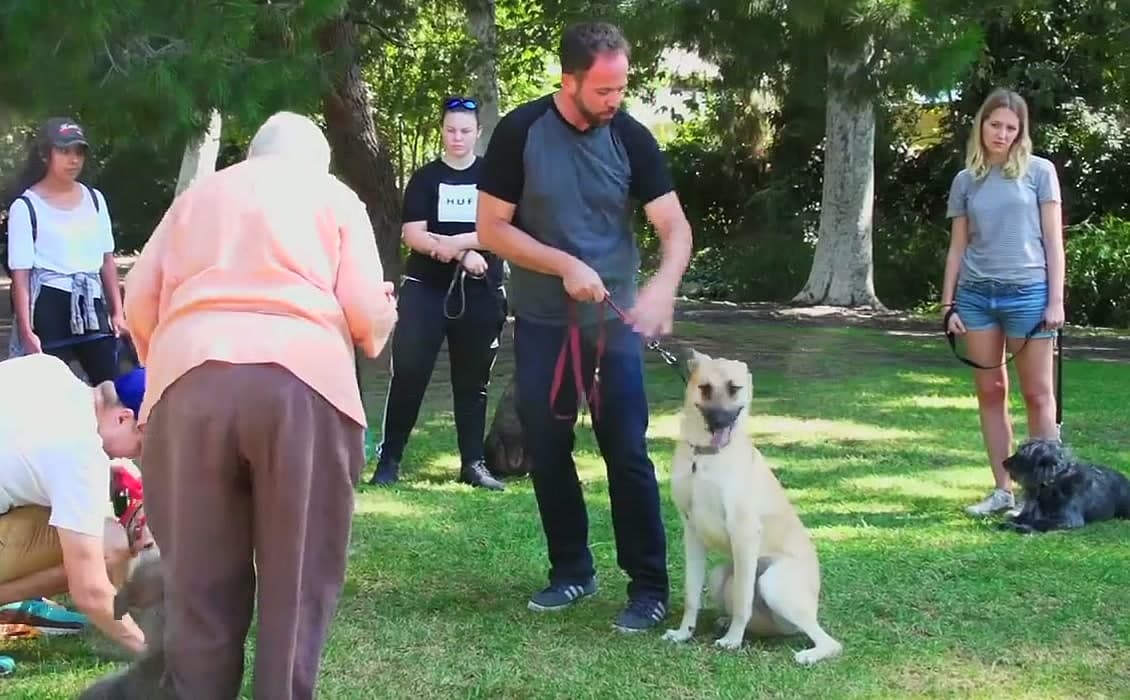
You will not see me shoveling treats at a barking dog. You cannot bribe a dog out of a meltdown it is already in, and a dog that only stays calm when food is present is not calm, it is distracted. Structure, leadership, and threshold work change what the dog actually does. Most of my clients see major change in the first ninety minute session, and every program includes lifetime support plus free group classes at the Sherman Oaks park, which give a reactive dog the one thing it needs most, controlled practice around other dogs.
If your dog barks and lunges on leash, call me at (310) 227 1424 for a phone evaluation. Thirty years and more than twenty thousand dogs have taught me that this problem responds fast once someone finally addresses the cause.