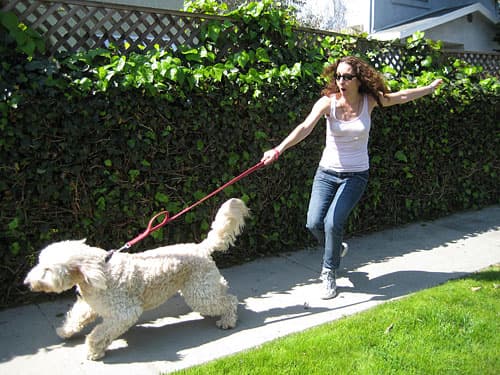
How do I stop my dog pulling on the leash?
Pulling is a structure problem, not a strength problem. Brett Endes, The Dog Savant in Los Angeles, teaches the dog that tension never produces forward movement, builds attention on the handler first, then proofs it on your actual street rather than in a training room.
A dog that drags you down the sidewalk is not being dominant and it is not being spiteful. It has simply learned that pulling works. Every time the dog pulls and the walk continues, the lesson lands: pulling moves me forward. Fix that one equation and the walk changes.
After thirty years and twenty thousand dogs, I can tell you the breed almost never matters. I have taught hundred pound shepherds and ten pound rescues to walk on a loose leash using the same principles. What matters is your timing, your structure, and your consistency.
Why your dog pulls in the first place
Dogs move faster than we do and the world is full of things they want to reach. The leash becomes a constant low level negotiation, and most owners accidentally reward the pulling by letting the dog get where it wants. The dog is not the problem. The pattern is the problem.
The goal is not to overpower your dog. It is to change what pulling earns. When forward motion stops the instant the leash goes tight, and resumes the instant it loosens, the dog learns that a slack leash is the only thing that works.
Start with the right equipment and position
Begin in a low distraction space like your driveway or a quiet street. Your dog belongs at your side, not three feet ahead. Decide which side, keep the leash short but not tight, and hold your hands at your waist so you are stable and predictable.
Most new clients I meet are walking their dog on the wrong equipment for that dog. The tool matters less than how you use it, but a dog that has rehearsed pulling for years often needs a clear, fair correction tool to break the habit. This is where a professional keeps it humane and effective.
The stop and reset method
When the leash goes tight, stop moving. Do not yank, do not drag, simply become an anchor. The walk does not continue until the dog releases the tension and the leash goes slack. The moment it does, praise and move forward again.
This is tedious for the first few walks. You may only travel half a block. That is normal. You are not on a walk yet, you are running a lesson. Within a week of consistent repetitions, most dogs start to self correct before they ever hit the end of the leash.
Proof it in the real world
A loose leash in your driveway is not the same as a loose leash past a barking dog. Once the basics are solid, raise the difficulty on purpose. Walk near other dogs, near squirrels, near the things that normally set your dog off, and hold the same standard every time.
Consistency across the whole household is what makes it stick. If one person enforces the loose leash and another lets the dog pull, the dog learns to gamble. Everyone walks the same way.