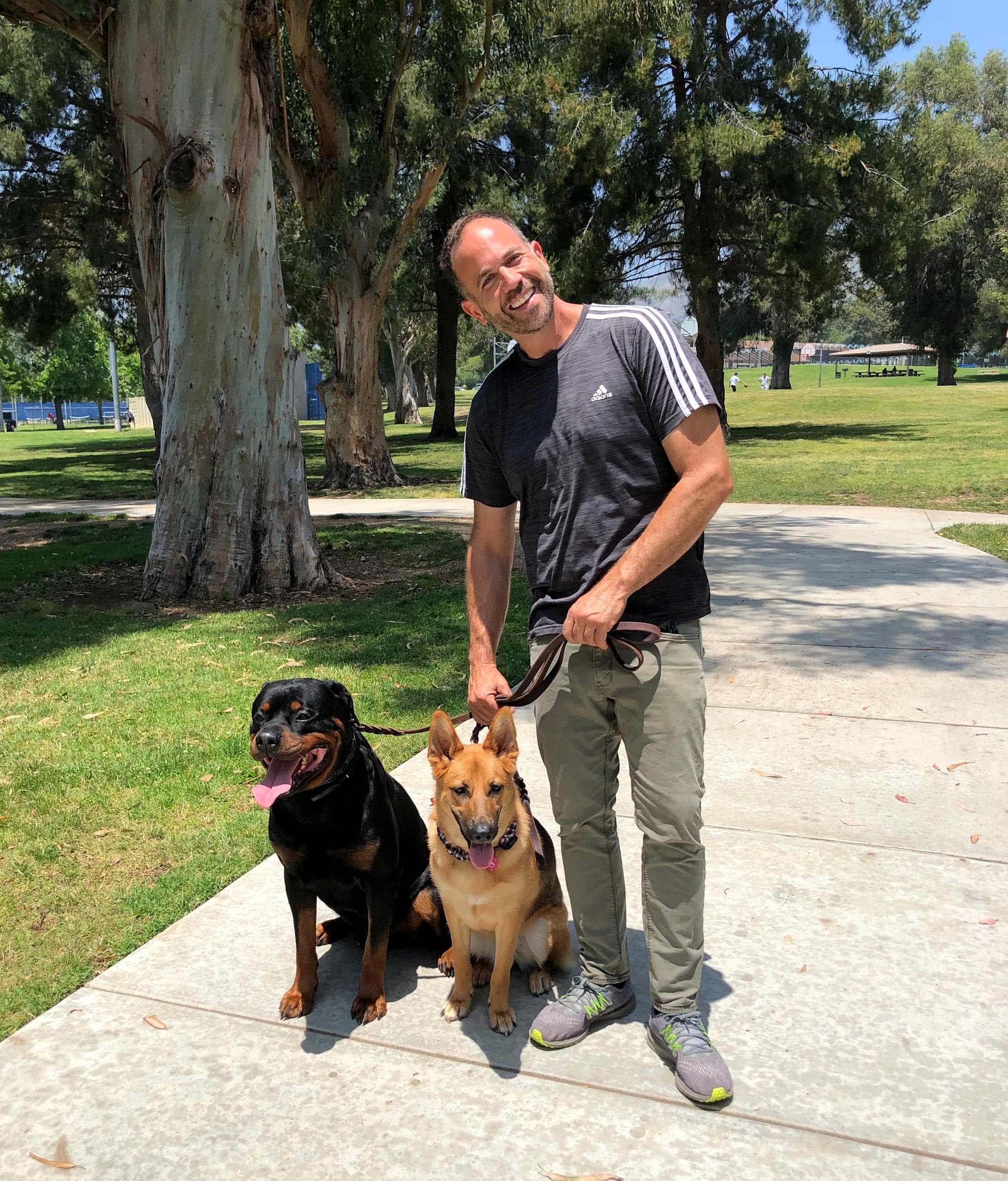
How do you train a German Shepherd?
A German Shepherd without a job invents one, usually guarding, barking or herding the household. Brett Endes, The Dog Savant in Los Angeles, gives the dog structure and real work, builds handler focus, and channels the drive instead of trying to suppress it.
I have trained thousands of German Shepherds in thirty plus years, and I can give you the breed's secret in one sentence: a shepherd without a job will invent one, and you will not like the job it picks. Window patrol. Leash enforcement. Screening your guests at the front door.
None of that is bad temperament. It is unemployment. The German Shepherd was built to work all day beside a handler it trusts, reading the flock, reading threats, making decisions. Put that brain in a Los Angeles living room with two short walks a day and it does not switch off. It freelances.
This guide covers what shepherd owners in LA actually deal with, the vigilance, the leash reactivity, the suspicion of strangers, the adolescent testing, and how balanced training turns the sharpest dog on the block into the calmest one.
Why shepherds struggle in Los Angeles
A German Shepherd processes everything. In a quiet suburb that is manageable. In Los Angeles, where there is a dog behind every fence, a skateboard on every block, and a delivery driver at the door six times a day, that radar never gets a break. The dog is not misbehaving, it is working a shift that never ends.
Apartments and small yards make it worse, not because shepherds need acreage, but because physical confinement plus mental unemployment is the exact recipe for the barking, pacing, and door explosions I get called about every week.
Vigilance is the breed, reactivity is the habit
People confuse the two constantly. Vigilance is your shepherd noticing the dog across the street. Reactivity is the rehearsed explosion that follows. The noticing was bred in over a century and you will not remove it. The explosion was learned in your hallway and on your sidewalk, and anything learned can be untaught.
Every rep matters. A shepherd that spends the afternoon barking at the window is not blowing off steam, it is practicing. Part of my first session in any shepherd home is shutting down the rehearsal so we can start teaching the alternative.
Leash reactivity, the pattern I see every week
The shepherd version of leash reactivity is usually frustration braided with suspicion. The dog wants information about the thing ahead, the leash says no, and the arousal has nowhere to go but out the front of the dog. Add an owner who tightens up at every corner, because they have learned to brace, and the dog reads that tension as confirmation that something is wrong.
I fix this on the streets you actually walk, not in a sterile training yard. Structure first, then threshold work at distances the dog can think through, then closer, until your shepherd can pass another dog like it is furniture. Most owners see the first real shift in session one.
Adolescence, when the sweet puppy starts testing
Somewhere between eight and eighteen months, the shepherd that followed you everywhere starts checking whether your words are load bearing. Commands it knows cold suddenly get a pause, a look, a negotiation. This is not defiance, it is a working dog asking who is actually running the operation.
This window is when more shepherds get surrendered than at any other age, and it is completely predictable and completely workable. The dogs do not need a heavier hand, they need a clearer one. Calm, consistent follow through, every time, from every person in the house.
Strangers and guests, discernment instead of suspicion
A good shepherd is naturally reserved with strangers. The problem starts when the dog appoints itself head of security and decides who gets in. The fix is not punishing the wariness, it is taking the job back: you answer the door, the dog goes to place and stays there, and your guest gets to walk in without an escort screening them.
Done right, your shepherd keeps everything that makes the breed magnificent, the loyalty, the awareness, the presence, and loses the part where your friends text from the driveway asking if the dog is put away.
What a trained shepherd actually looks like
Calm power. A dog that walks past other dogs on a loose leash, settles on its place while life happens around it, and turns on exactly when you ask, not when it decides. Shepherds do not become less impressive with training, they become more, because all that intelligence finally has somewhere to go.
I train in your home across Los Angeles and the San Fernando Valley, and every program includes lifetime support and free group classes at the park in Sherman Oaks, which is the perfect controlled environment for a shepherd to practice neutrality around other dogs. If your shepherd runs your house instead of the other way around, call (310) 227 1424 and we will fix that.